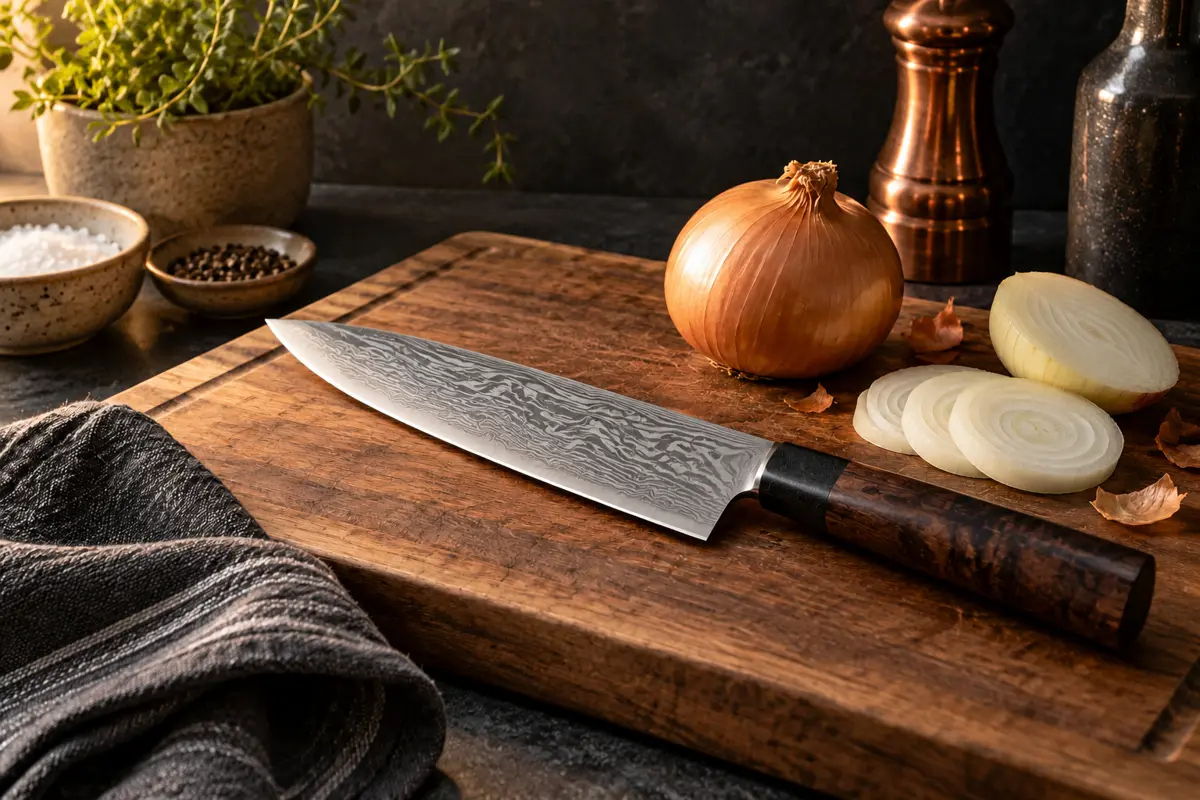
A good chef's knife should feel predictable, comfortable and easy to maintain. It does not need to be the most expensive knife in the store, and it definitely does not need the longest list of technical specifications.
In a working kitchen, the useful question is simple: does this knife make prep easier, safer and more consistent?
Chef Alex's starting point
For most home kitchens, I would start around an 8-inch chef's knife. Not because 8 inches is magically better, but because it gives you enough blade for cabbage, squash, herbs and larger batches of vegetables without becoming awkward on a normal home cutting board.
A 6- or 7-inch knife can be a great choice if you have smaller hands, limited counter space or simply prefer a more compact blade. A 9- or 10-inch knife gives you more cutting length for high-volume prep, but extra size is only useful if you are comfortable controlling it.
Do not buy a knife to impress the person standing beside you. Buy the size you actually want to use.
What I actually use
In my own kitchen, I use Miyabi knives with D-shaped handles.
That is a personal fit choice, not a rule that everyone should buy the same knife. I like having a handle shape that gives me a consistent, familiar position in the hand. Your hand size, grip and cutting style may make a completely different handle feel better.
That is exactly why I put handle comfort ahead of brand name when choosing a knife.
Handle comfort matters more than looks
Pick the knife up properly before judging the handle.
Use a pinch grip, with your thumb and index finger controlling the blade just ahead of the handle. Then notice what happens to your hand and wrist.
Look for:
- pressure points or sharp corners;
- a handle that feels slippery;
- excessive weight at the back of the knife;
- a shape that forces your wrist into an awkward position.
A beautiful handle is not much use if you want to put the knife down after ten minutes of prep.
SEE THE DIFFERENCE · HANDLES
Find the shape that fits your hand.
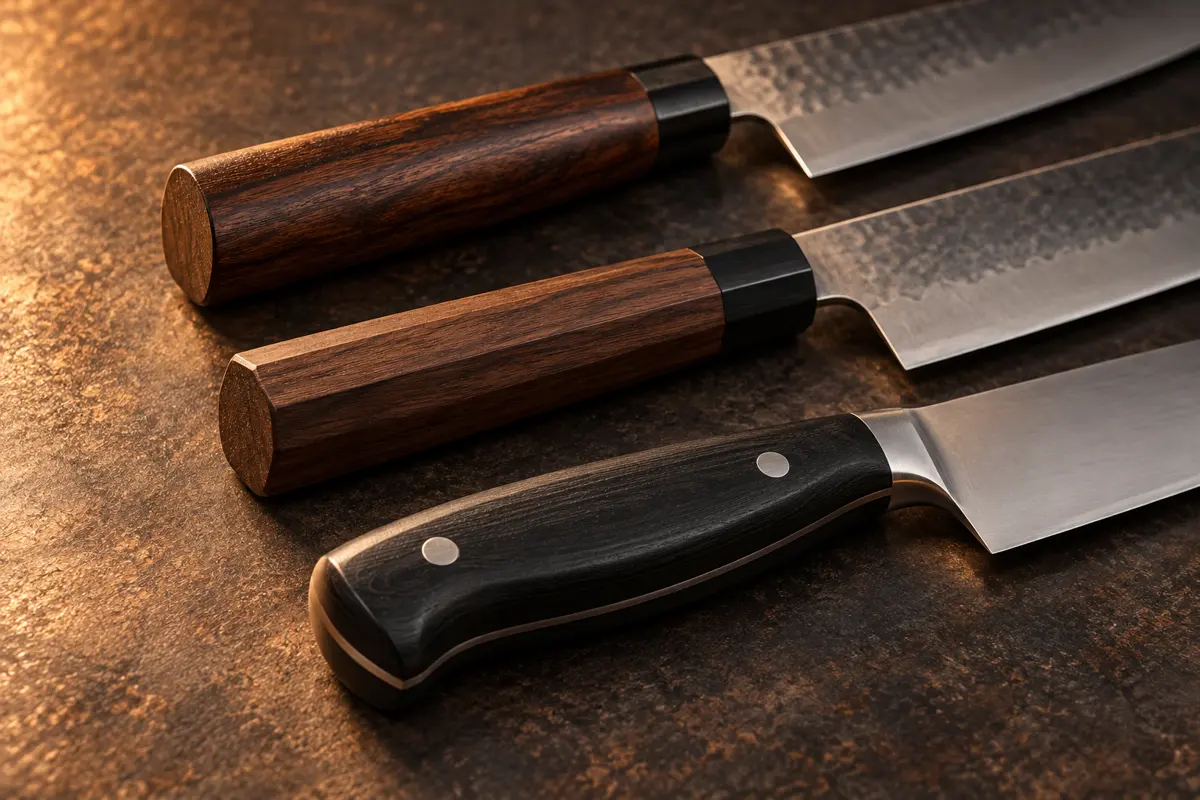
The end-view sketches below simplify the shapes. Actual handles vary in size, taper and orientation.
D-shaped
An asymmetrical profile with a flatter side and a rounded side. Alex uses D-shaped Miyabi handles; fit is personal. Check the maker’s handedness guidance and try the grip.
Octagonal
Eight faces give your fingers distinct reference surfaces. Check the actual handle’s thickness and taper rather than assuming every octagonal handle feels alike.
Contoured / Western-style
Often shaped along its length, with an oval or rounded end profile. Rivets are a construction detail; they do not tell you whether the handle will fit your hand.
Try this: hold the knife in your normal pinch grip and notice pressure points, balance and wrist position. The best-looking handle is not automatically the most comfortable.
Shape reference: Shun’s handle-profile comparison. Illustrations are generic, not product recommendations.
Blade geometry changes how a knife cuts
This is one of the areas I would pay attention to before worrying about fancy steel names.
A relatively thin blade behind the cutting edge usually moves through onions, carrots and other vegetables with less resistance. A thick, heavy blade may feel substantial in your hand but can wedge in dense ingredients.
That does not mean thinner is always better. The goal is a blade suited to the work you actually do.
If most of your cooking is vegetables, herbs and general prep, I would favour an efficient cutter over unnecessary bulk.
Steel is always a trade-off
Knife marketing can make steel sound like a competition where the biggest hardness number wins. It is not that simple.
Harder steels can hold a fine edge for longer, but some can be less forgiving and more demanding to sharpen. Tough, corrosion-resistant stainless steels may need sharpening a little more often but can be much easier to live with in a busy home kitchen.
No knife steel stays sharp forever.
For most people, I would rather see a sensible steel paired with a sharpening routine they will actually use than an exotic steel that becomes dull because nobody wants to maintain it.
SEE THE DIFFERENCE · BLADE MATERIALS
The finish is visible. The steel specification is not.
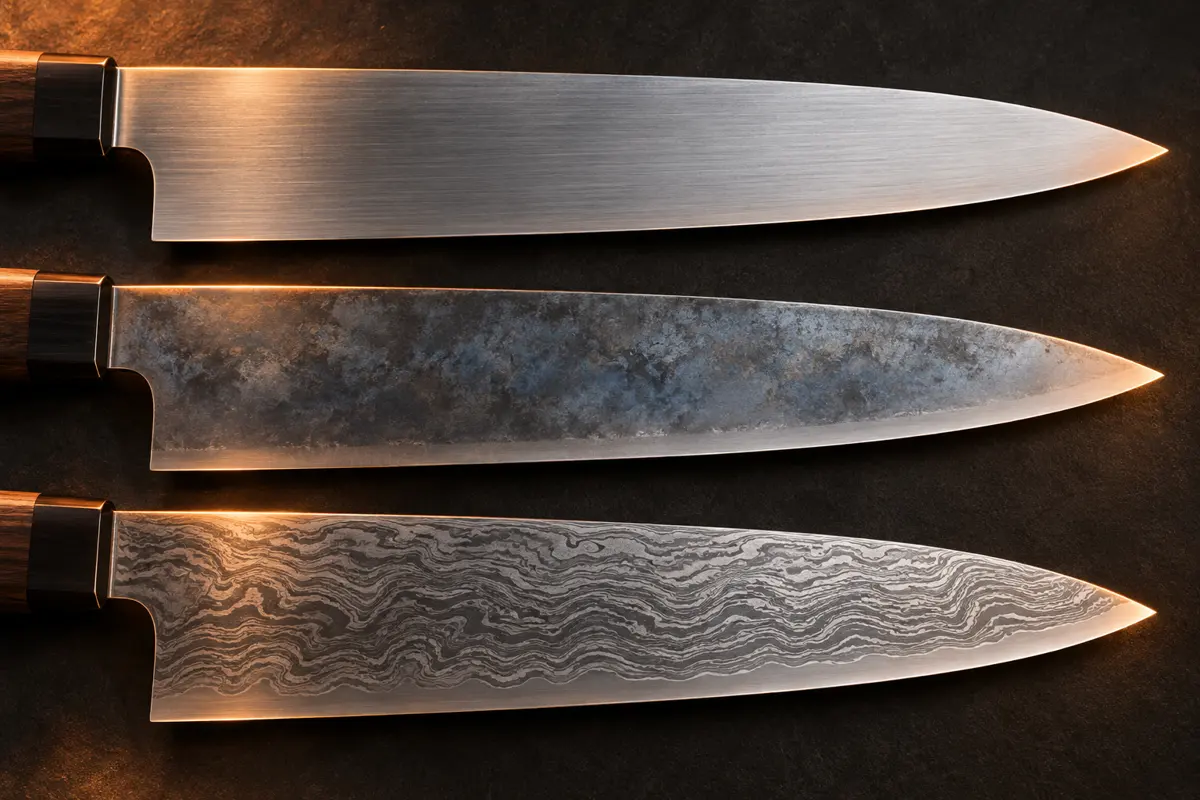
A plain blade can be stainless or reactive carbon steel. A layered pattern can appear on different constructions. These pictures show surface appearances, not a way to identify an alloy.
Plain / satin finish
A relatively even surface tells you about the finish. It does not reveal the steel grade, heat treatment or edge retention.
Patina
Reactive carbon steel can develop blue-grey colour through use. Patina and rust are different; blade care still matters.
Damascus pattern
The visible waves are not a steel grade or a performance guarantee. Check the cutting-core steel and the maker’s care instructions.
| Term | What to check |
|---|---|
| Stainless steel | Corrosion resistance and the actual grade. Stainless does not mean maintenance-free. |
| Reactive carbon steel | Whether you want the extra attention to wiping and drying, and a blade that changes colour. |
| Powder metallurgy | A manufacturing route, not a visible finish. Look up the named steel and the finished knife’s specification. |
| Damascus / layered cladding | How the blade is constructed and what steel forms the cutting edge. Pattern alone does not answer either question. |
Buying takeaway: choose the care level, geometry and sharpening plan that suit your kitchen. A more dramatic pattern does not automatically make prep easier.
References: Japanese Knife Imports on steel and patina · Shun’s blade and construction specifications.
Your cutting board is part of the knife system
You can buy an excellent knife and ruin the edge quickly by using the wrong surface.
Avoid cutting directly on:
- glass;
- stone;
- ceramic;
- hard decorative serving surfaces.
Wood and quality plastic boards are generally much friendlier to knife edges.
Size matters too. Your board should give you enough working room that ingredients are not constantly falling onto the counter. A good knife on a tiny board is still an annoying setup.
SEE THE DIFFERENCE · BOARDS
Choose a prep surface, then a serving surface.
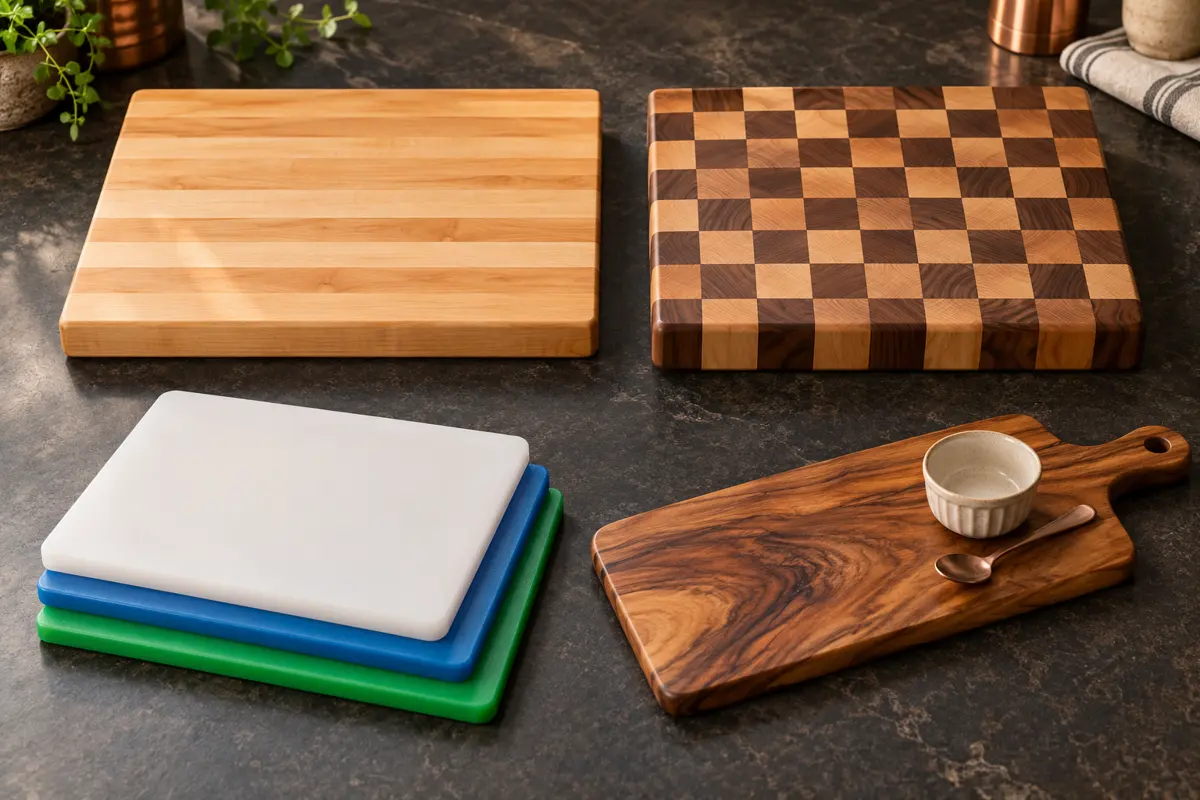
Edge-grain wood
Long wood strips run across the face. Look for enough working space, stability and a maintenance routine you will follow.
End-grain wood
Short blocks stand on their ends, often giving a checkerboard appearance. Construction and upkeep matter more than the pattern alone.
Plastic prep boards
Colour can help you organise tasks. Keep a separate board for raw meat, poultry and seafood from ready-to-eat foods. Follow the maker’s cleaning instructions.
Serving boards
A paddle or platter gives cheese, bread and small bowls room to work. A decorative serving surface is not automatically suitable for chopping.
Alex’s approach: practical, colour-coded boards for prep; a custom wood board for presentation. Do not assume every wooden or plastic board is dishwasher-safe.
Read more: John Boos on wood construction · USDA cutting-board care and separation.
Decide how you will sharpen it before you buy it
A knife is only as useful as its edge.
Before spending serious money, decide how sharpening will happen. Your realistic choices might include:
- whetstones;
- a guided sharpening system;
- a reputable professional sharpening service.
Honing and sharpening are not the same thing. Honing can help maintain or realign some edges between sharpening sessions, but eventually material needs to be removed to restore a genuinely sharp cutting edge.
Choose a maintenance method you will actually follow.
What I would pay more for
I am willing to spend more when the extra money produces something useful:
Better geometry. A knife that cuts cleanly with less resistance is noticeable every time you use it.
Comfort. If you prep frequently, a handle and balance that suit your hand matter.
Reliable construction. The knife should feel secure, stable and built for repeated use.
Useful edge retention. Longer edge life can be valuable as long as sharpening does not become impractical.
A manufacturer that stands behind the product. Warranty and long-term availability matter more to me than decorative packaging.
What I would not automatically pay extra for
Some expensive features do not necessarily make dinner easier.
I would not choose a knife primarily because of:
- decorative finishes;
- an elaborate presentation box;
- a large matching knife block;
- an unusually high steel-hardness number by itself;
- a celebrity name;
- a long list of knives bundled together that you may never use.
A smaller collection of knives you genuinely use is better than a countertop block full of blades you avoid.
The three-knife reality
You do not need twelve knives to run a capable home kitchen.
For many cooks, a strong basic setup is:
- a chef's knife for most prep;
- a small paring or utility knife for detail work;
- a serrated knife for bread and foods where a toothed edge is useful.
Add specialty knives when your cooking gives you a reason to need them.
My practical buying checklist
Before buying a chef's knife, I would ask:
- Does the blade length suit my board and workspace?
- Is the handle comfortable in a pinch grip?
- Does the knife move through food without excessive wedging?
- Is the steel appropriate for the amount of maintenance I want?
- Can I keep it sharp?
- Am I paying for performance, or mostly for appearance and branding?
If those answers make sense, you are much closer to the right knife than you are by shopping from price alone.
Bottom line
There is no single best chef's knife for everyone.
For a first serious knife, I would prioritize comfortable grip, useful blade length, sensible geometry, corrosion resistance and a sharpening plan you will actually follow.
Spend more when the improvement affects the way the knife cuts, feels or lasts. Save your money when the premium is mostly decoration or marketing.
As Kitchen Chaos adds specific knife recommendations, they will be chosen because they fit these criteria — not simply because a brand has an affiliate program.